Summary
Worked on a miniature concrete 3D printer at a construction-tech startup. The research team knew what experiments they wanted to run. My job was to figure out what the system needed to do, and then get it built and working.
Context
Construction-tech startup working on concrete 3D printing systems.
The Problem
- Most concrete 3D printers are designed for large-scale construction; they are expensive and poorly suited for research.
- Existing desktop printers struggle with construction materials due to clogging, abrasion, and inconsistent flow.
What I Worked On
A research-focused concrete 3D printer.
-
Supports printing with concrete & other paste-type materials -
Prioritizes modularity & ease of cleaning
My Role
Worked across requirements, mechanical design, integration, and testing. Involved at every stage where decisions got made, not siloed into one area.
When something failed during testing, the question was always: is this fixable, is there a workaround, or is this a constraint we accept? Iterated quickly and shipped a system that researchers could actually use.
Outcomes
20% accuracy improvement
Print precision improved through iterative material flow tuning across multiple test cycles.
15% waste reduction
Modular extrusion design reduced material waste during setup and between experiment runs.
Research-grade at lab budget
Delivered a fully functional research instrument at a fraction of the cost of commercial alternatives.
Problem Context
Output scale vs. Learning speed
Concrete printing systems are typically optimized for output scale, not learning speed. For research teams, the real challenge is repeatability, ease of iteration, and system maintainability.
This project focused on rethinking the printer as a research instrument, not a production machine.
Product Goals
System Architecture
Motion System
- Cartesian-style motion for predictable and accurate positioning.
- Chosen for simplicity, stability, and ease of maintenance.
Material Handling
- Batch-based material storage and delivery system.
- Designed to minimize clogging and simplify cleanup after experiments.
Extrusion System
- Mechanically driven extrusion to handle dense materials.
- Interchangeable components to support different material types.
Key Design Decisions
Tradeoffs were made intentionally based on research workflows.
Modularity over Coupling
Prioritized modular designs to ensure subsystems could be independently serviced or upgraded.
Research over Throughput
Optimized for reliability during experiments rather than raw printing speed.
Accepted Limits
Accepted known constraints in exchange for higher reliability and usability for researchers.
Real-world Focus
Focused on learning from real prints rather than theoretical performance metrics.
Testing & Results
- Conducted subsystem-level testing to validate basic functionality.
- Iterated on material flow and extrusion consistency.
Learnings
- Material handling is the dominant constraint in concrete printing.
- Maintainability matters as much as print quality in research setups.
In Action
Printer in operation
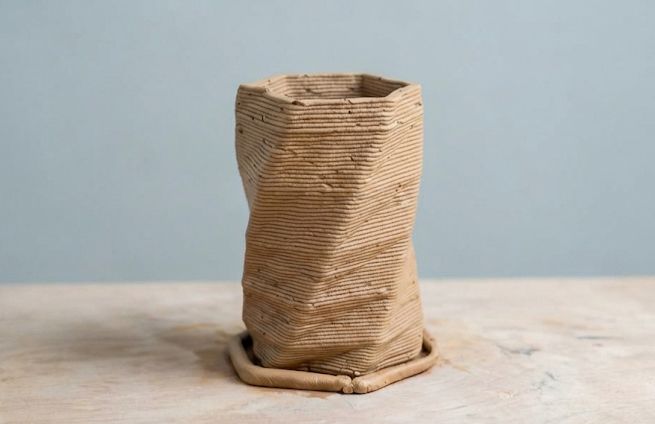
Printed sample
Non-proprietary views only
Requirements don't come pre-written.
The biggest product skill here wasn't engineering. It was translating a vague research need into a spec the team could build against, then staying close enough to the build to catch when reality diverged from the plan.